
Use cases · Community
Customers vote on a budget
Set a yearly budget and let customers, employees or policyholders decide where it goes.
- Who paysYour company
- Starts withA customer action
- Tax receiptIn your company's name
Needs API access on a validated account. Plans
your-brand.example/vote
Step by step
Click through the site. Each step shows what your customer does, what your server sends and what Charitips answers.
1Vote created
To comeYour customer does…
Clicks “Vote for the charity”.
Your server sends…
Creates a vote of weight 1 for customer #204 on the campaign “Our 2026 budget”.
POSTcreate-vote
Charitips answers…
Charitips creates the vote and returns its id.
Charitips will then tell your server the vote was created.
2Vote cast
To comeYour customer does…
Clicks “Vote for the charity”.
Your server sends…
Casts that vote for the charity your customer picks.
POSTcast-vote
Charitips answers…
The vote counts for the charity your customer picks.
Charitips will then tell your server the vote was updated.
3Second vote refused
To comeYour customer does…
Clicks “Simulate a second vote”.
Your server sends…
Casts that vote for another charity.
POSTcast-vote
Charitips answers…
Charitips refuses the call: this was already done, so the first one stands.
How to read this demo: the site shows what your customer does, and the panel what your server sends and what Charitips answers, step by step.
The site is made up and nothing is sent. The endpoints, fields and webhook events are the real ones, and so are the charities.
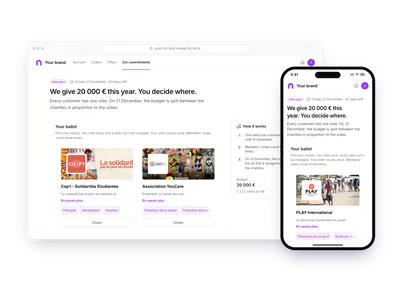
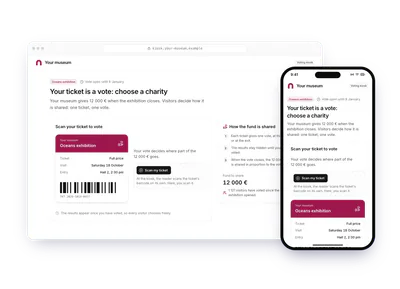
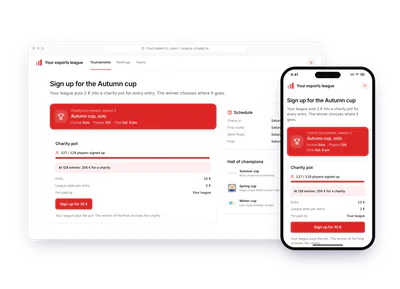
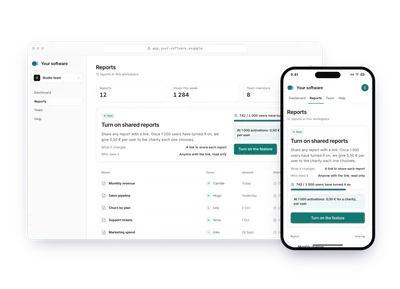
This demo is one example. Customers split a yearly budget: that is the case the demo plays. The same flow also covers:
One flow, 5 variants
Each card is this flow in another sector or use case. Pick one: the demo above plays it, with its site, its amounts and its charities. The API calls stay the same.
Build it
The calls behind the demo, in order. Each step shows the request your server sends.
vote_createvote_updatedonation_createdonation_updateBefore you start
- A
DISTRIBUTION,FIXED_AMOUNTcampaign with a budget, billed when it is activated.
Create the vote campaign
Set up a campaign as in steps 3 to 5 of Your first donation, with
typeset toTIME_BASEDand anendDate,donationTypeset toDISTRIBUTION,amountTypeset toFIXED_AMOUNT, abudgetin cents and thecharitiesSelectionIdof the charities people can vote for. The budget is whatever you set, for example 2 % of last year's profit. ADISTRIBUTIONcampaign takes votes only: the API refuses donations on it.POST /v1/campaignscurl -X POST https://api.sandbox.charitips.com/v1/campaigns \ -H "Authorization: Bearer $CHARITIPS_TOKEN" \ -H "Content-Type: application/json" \ -d '{ "name": "Customer vote 2027", "charitiesSelectionId": "<charitiesSelectionId>", "type": "TIME_BASED", "endDate": "2027-12-31", "donationType": "DISTRIBUTION", "amountType": "FIXED_AMOUNT", "budget": 2000000 }'Built from the spec and the API codeRequest bodies are written for this docs and checked against the API's validation; ids in angle brackets are placeholders. Response values are placeholders built from the schema.
Activate the campaign
Activate it with Activate a campaign. The budget is billed at activation.
POST /v1/campaigns/<campaignId>/activatecurl -X POST https://api.sandbox.charitips.com/v1/campaigns/<campaignId>/activate \ -H "Authorization: Bearer $CHARITIPS_TOKEN"Built from the spec and the API codeRequest bodies are written for this docs and checked against the API's validation; ids in angle brackets are placeholders. Response values are placeholders built from the schema.
Create one vote per person
Create one vote for each person, with your id for them as
uniqueExternalId.weightlets some votes count more.POST /v1/votescurl -X POST https://api.sandbox.charitips.com/v1/votes \ -H "Authorization: Bearer $CHARITIPS_TOKEN" \ -H "Content-Type: application/json" \ -d '{ "campaignId": "<campaignId>", "uniqueExternalId": "employee_4410" }'Built from the spec and the API codeRequest bodies are written for this docs and checked against the API's validation; ids in angle brackets are placeholders. Response values are placeholders built from the schema.
Cast each vote
Cast each vote for the charity the person picks. When the campaign ends, the budget is shared in proportion to the cast votes and their
weight; a vote never cast does not count.POST /v1/votes/<voteId>/castcurl -X POST https://api.sandbox.charitips.com/v1/votes/<voteId>/cast \ -H "Authorization: Bearer $CHARITIPS_TOKEN" \ -H "Content-Type: application/json" \ -d '{ "charityId": "<charityId>" }'Built from the spec and the API codeRequest bodies are written for this docs and checked against the API's validation; ids in angle brackets are placeholders. Response values are placeholders built from the schema.
Or send each person a voting link
Instead of casting from your server, let each person vote on a page Charitips hosts. Get a vote with
includeUrl=truereturns the vote'surl, a link for that person only: send it by email or show it in your product, and the vote is cast when they choose. To keep the choice inside your product, show the charity selection widget with theclaimtype and the vote'ssecretasvoteSecret.GET /v1/votes/<voteId>curl -X GET https://api.sandbox.charitips.com/v1/votes/<voteId> \ -H "Authorization: Bearer $CHARITIPS_TOKEN"Built from the spec and the API codeRequest bodies are written for this docs and checked against the API's validation; ids in angle brackets are placeholders. Response values are placeholders built from the schema.
Edge cases
- Someone votes twice. The second cast returns
409 Vote already casted. - Anyone can vote, without a link. Create the campaign with
audienceTypeset toPUBLIC: anyone who opens its page votes, without a vote created in advance, so the number of votes is not known beforehand. Get a campaign withincludeSiteUrl=truereturns the page's address. APRIVATEcampaign, the default, only takes the votes you create.
The memo
Send the memo to your team
Already written for this flow
- What it does and who pays, in a few sentences
- What you need: plan, API calls and webhooks
- What you can report: donations, charities, impact and receipts
To paste in an email, a document or a note.
Email it